Foldables remain a rounding error in global smartphone shipments, but they punch far above their weight in attention — a bit like supercars in a city full of hatchbacks. Most people will never buy one, but everyone slows down to look.
At CES 2026 in Las Vegas, Samsung’s Galaxy Z Tri-Fold is not trying to make foldables mainstream overnight. Instead, it is doing something more deliberate and arguably more honest: shifting the conversation away from “how thin can we make a phone” to “how much more can a phone do”.
With slab phones entering their Toyota Corolla phase — reliable, competent, and deeply predictable — the Tri-Fold feels like Samsung taking a purposeful left turn. The bet is simple: if people already treat their phones like pocket computers, why not give them more screen to actually work on?
Where I Saw It And How Much Time I Had
I spent around seven to eight minutes with the Galaxy Z Tri-Fold at Samsung’s First Look event on the sidelines of CES. If you’ve ever done CES, you know this is barely enough time to form a relationship — more speed date than long dinner.
This was peak CES energy: blinding lights, noise levels that would scare a nightclub sound engineer, and devices that disappear back into glass cases the moment your curiosity peaks. These are first impressions in the truest sense — a handshake, not a handshake deal.
The Folding Mechanism, Explained Like A Human
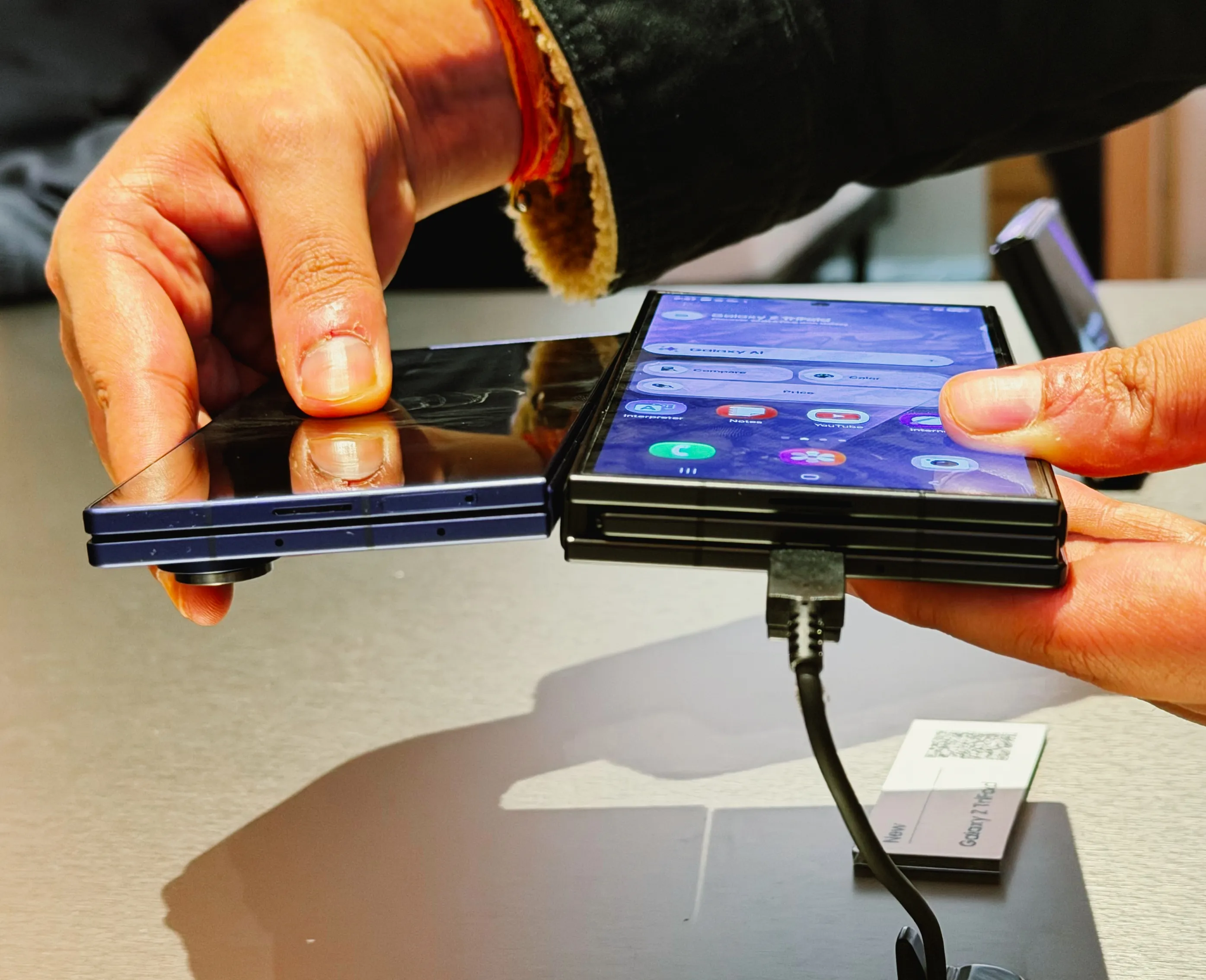
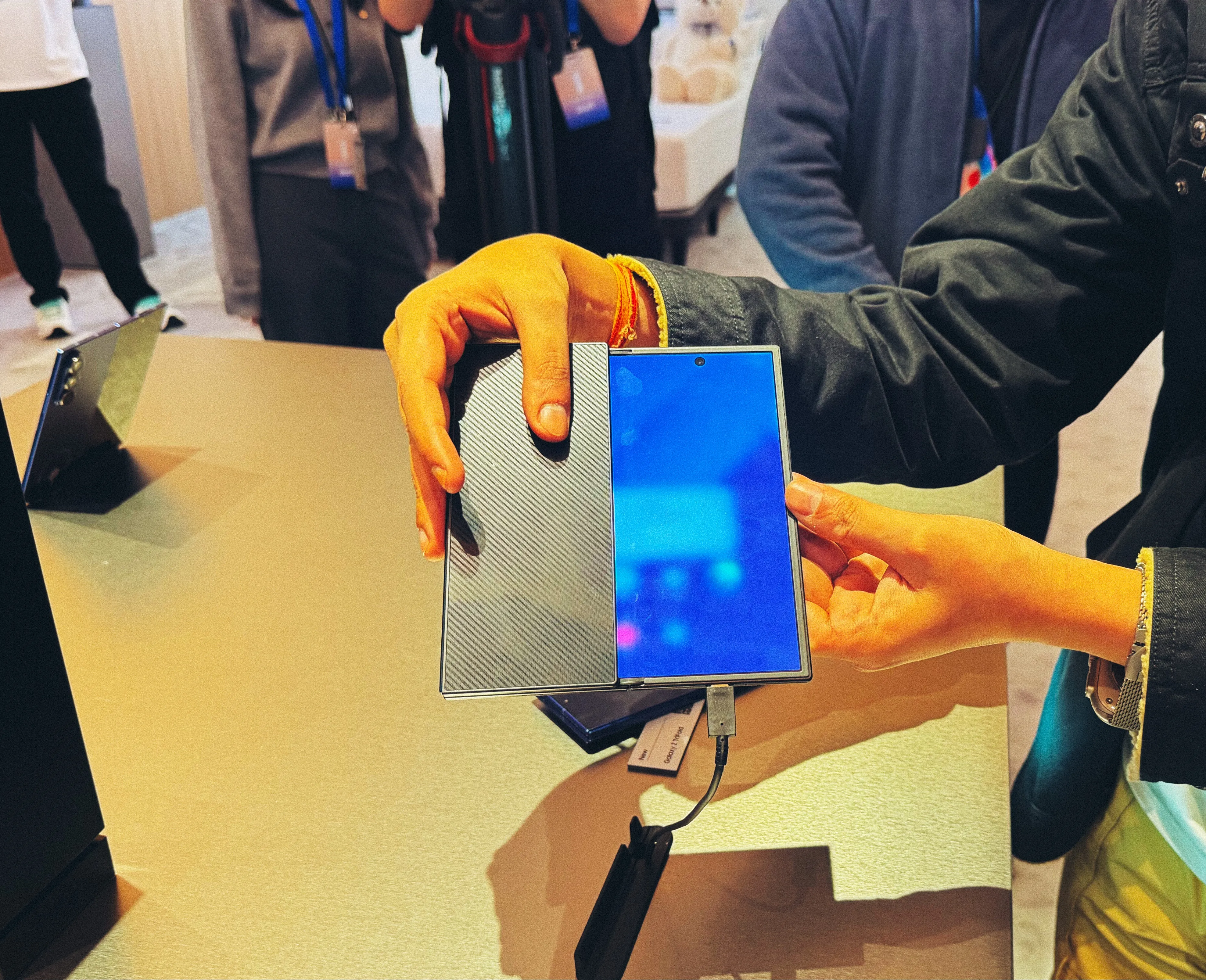
Samsung’s Tri-Fold uses a U-type inward-folding mechanism. In plain English: the screen folds inward twice, stays protected when closed, and unfolds into three connected panels when fully open. You go from a 6.5-inch outer screen to a 10-inch canvas in one continuous motion.
Huawei’s tri-fold approach takes a different route. Its outward, accordion-style fold prioritises flexibility, letting panels fold over each other externally. That gives more in-between configurations, but also leaves parts of the display exposed. Samsung has chosen the safer philosophy: fewer tricks, more protection.
Think armoured SUV versus carbon-fibre concept car. Samsung is not chasing elegance here. It is chasing survivability.
The trade-off is obvious. There is no graceful halfway posture. No laptop-style angle you can pretend is a new category. This device commits. It is either phone or tablet. Nothing in between.
Design And Feel: The Moment Your Pocket Files A Complaint
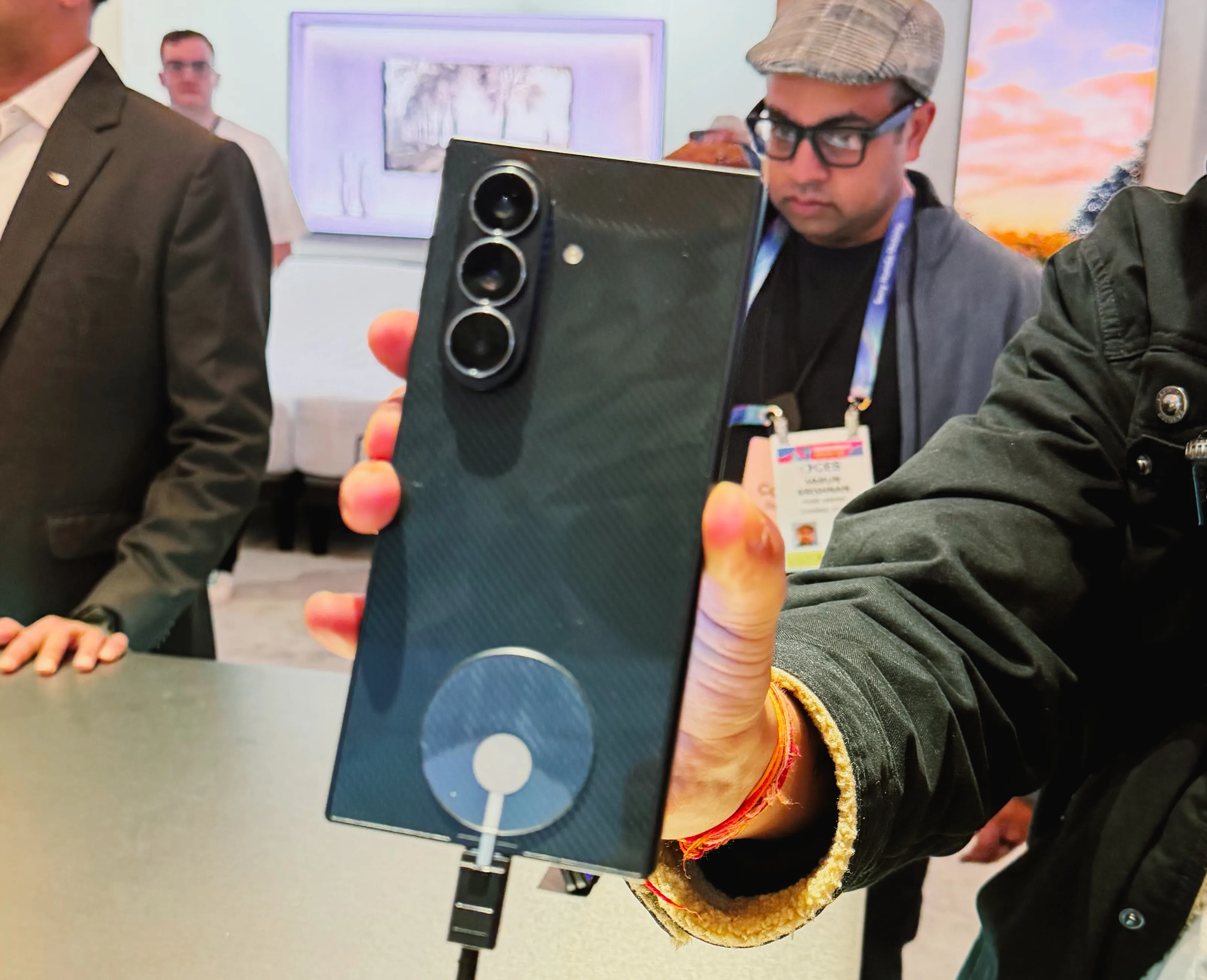
Let’s not dance around it. This is a thick device when folded.
Not clumsy, not crude — but unmistakably present. The physical sensation immediately reminded me of Samsung’s first-generation Fold, not in build quality, which is far more mature here, but in mass. This is not a phone that disappears into skinny jeans. This is a phone that asks you to rethink your jeans.
If normal flagships are tailored blazers, the Tri-Fold is a touring jacket — padded, purposeful, and unapologetic. Huawei’s tri-fold concepts may look sleeker in photos, but Samsung’s feels like it expects real life: backpacks, airport security trays, café tables, and that moment when your phone slides off the sofa.
And yes, the creases are visible. Two of them. You notice them the way you notice the first scratch on a new watch. It irritates you briefly. Then your brain moves on and gets back to work.
The 10-Inch Moment: Where It Starts Making Sense
Everything clicks when the device is fully open.
A 10-inch canvas changes the experience in a way smaller foldables never quite manage. Video finally breathes. Letterboxing grief — the quiet enemy of book-style foldables — largely disappears. Content stops feeling squeezed and starts feeling intentional.
This is where Samsung’s approach diverges from Huawei’s. Huawei chases flexibility of form. Samsung chases relief. And for watching, reading, and working, relief wins.
Stop judging the Tri-Fold as a phone and start judging it as a portable screen you can fold shut, and suddenly the compromises feel… negotiable.
Productivity And DeX: Samsung Playing To Its Strengths
This is where Samsung’s long game shows.
DeX on a regular phone always felt like playing a full-size guitar through a travel amp — impressive, but constrained. On the Tri-Fold, DeX finally has room to breathe. Windows sit where they should. Apps stop overlapping like awkward conversations at a party.
I was writing this piece on an iPhone 17 Pro Max from the CES floor — perfectly doable, the way surviving on protein bars is doable. The Tri-Fold promises a proper meal. Add a keyboard and suddenly this feels less like a phone pretending to be a laptop, and more like a laptop that forgot how to be shy.
Huawei does not yet offer a comparable, globally familiar desktop-style workflow. Samsung does — and on a tri-fold, that advantage compounds quickly.
Cameras, Chip, Battery: Flagship Parts, Open Questions
Samsung positions the Tri-Fold firmly at the top of its hardware stack. It uses the same Snapdragon 8 Elite platform and triple-camera system seen on its flagship foldables, including a 200-megapixel main camera.
The battery is a 5,600 mAh unit spread across the device, but Samsung has not adopted silicon-carbon battery technology seen in some Chinese rivals, including Huawei. Battery life, therefore, remains a question mark — especially in a device that actively encourages multitasking.
In my brief time, the hardware felt premium and the display looked vibrant. Endurance, thermals, and long-term comfort will only reveal themselves with real-world use.
Galaxy AI, Gemini, And Large-Screen Software
Samsung’s Galaxy AI and Google Gemini integration feel more purposeful on a 10-inch screen than on a standard phone. With more visual space, AI stops being a novelty tucked into menus and starts acting like a helper you can actually see working.
Summaries, rewrites, translations — all make more sense when they do not steal space from what you are doing. The promise is clear. Whether it becomes habit depends on polish and consistency beyond the demo floor.
Availability And The India Reality Check
Samsung has confirmed that the Galaxy Z Tri-Fold will launch initially in the US, South Korea, the UAE, and Singapore. India is not on that list.
That is not a footnote. It is a reminder that tri-folds are still experimental territory — luxury curiosities aimed at specific markets rather than mass adoption.
Huawei’s tri-fold ambitions are similarly constrained geographically. This is a category still finding its footing.
US Pricing: The Number Everyone Asks, And No One Loves
Samsung has not announced an official price, but early hands-on reporting consistently anchors expectations around $2,500 in the US.
Converted at current exchange rates, that works out to roughly Rs 2.25 lakh. In the grey market, often imported units from the middle east, cost 2x.
This is not “expensive phone” money. This is “do I buy this or a MacBook Pro?” money.
It is the kind of price that makes people say things like “it replaces two devices” and “I’ll use it for work”. Sometimes those sentences are true. Sometimes they are emotional support.
Who This Is For — And Who Should Walk Away
If your phone is already your primary computer, if you live in split screens and cloud documents, and if you value canvas over compactness, the Galaxy Z Tri-Fold makes a persuasive case. It feels like Samsung’s most honest attempt yet at replacing two devices with one.
If, however, you want pocketability, minimalism, and the psychological comfort of thin hardware, this is not your device — and Samsung is not pretending otherwise.
Seven to eight minutes with the Galaxy Z Tri-Fold were enough to understand its intent. It is not subtle. It is not trying to be. It is a phone for people who like their technology the way they like their music loud and their screens wide.
Samsung Galaxy Z Tri-Fold Specifications
Specification
| Details
| Form Factor
| Tri-fold smartphone with inward U-type folding
| Cover Display
| 6.5 inches
| Main Display
| 10 inches (fully unfolded)
| Folding Style
| Inward fold (screen protected when closed)
| Processor
| Snapdragon 8 Elite
| Rear Cameras
| Triple-camera system, including 200-megapixel main sensor
| Battery
| 5,600 mAh (non silicon-carbon)
| Software
| Android with Galaxy AI and Google Gemini
| Productivity
| Samsung DeX supported directly on device
| Creases
| Two visible creases on main display
| Launch Markets
| US, South Korea, UAE, Singapore
| India Launch
| Not confirmed / not announced
| Expected US Price
| Around $2,500
| Approx India Price (Converted)
| Around Rs 2.25 lakh
|
|





