The discussion with Dino Bekis revolved around the company’s vision for personal AI, particularly in wearables like smartwatches and earbuds. Bekis highlighted rapid advancements in AI capabilities and the shift towards more proactive, agent-centric AI. Key areas of focus include power efficiency, high-performance computing, and leadership connectivity.
The company is exploring how to integrate advanced AI into smaller form factors, enabling devices to provide real-time, actionable insights and context-aware assistance, moving beyond simple data collection.
The conversation also touched upon the role of RISC-V architecture and the challenge of managing the increasing volume of data by transforming it into actionable information.
Qualcomm is already thinking about products 5 to 10 years ahead in time, investing in IP roadmaps that require 5 to 7 years of development before hitting the market. The core foundations for this future include a continued relentless push towards power efficiency, high-performance computing, and connectivity.
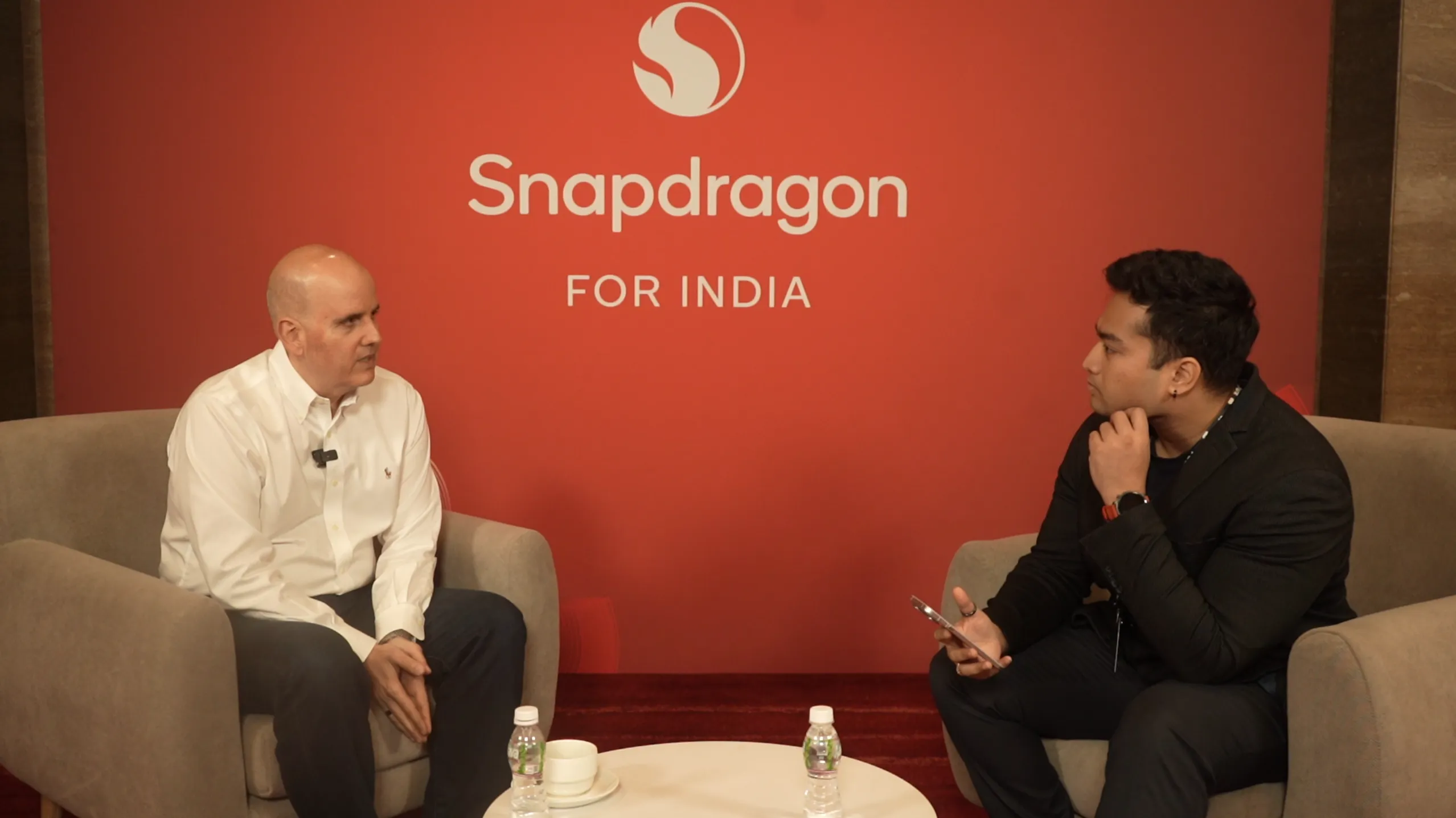
Bekis emphasised that local compute and power efficiency are critical, encompassing NPU, CPU, and GPU, focusing on faster processing, more time-constrained operations, lower latency, and maintaining multiple days or weeks of battery life. He also added that devices are transitioning from occasional use to always-sensing, always-on functionalities, driving innovations in process technologies and architectures to achieve necessary power consumption levels.
Later during the event, Qualcomm announced not one, but two new chips, the Snapdragon 6 Gen 5 and Snapdragon 4 Gen 5. The chipsets will power high-volume smartphones, i.e., budget and mid-range smartphones that hold the majority chunk of the Indian smartphone market in volume. Not only this, Boat announced its new audio product, the Nirvana Utopia Eutopia 2 Pro, which will use Qualcomm’s Sound S3 Gen 1 chip. Bekis was accompanied by Boat's Chief Product Officer, Shyam Vedantam, and CEO, Gaurav Nayyar.
Dino Bekis has spent years steering Qualcomm's wearables division through what he freely admits has been an unremarkable stretch of incremental progress. That stretch appears to be over. With the explosion of agentic AI capabilities and a generational leap in on-device compute, Bekis is unusually animated about what lies ahead.
Speaking on the sidelines of a technology event, he makes the case that the smartwatch on your wrist, the earbuds in your ears, and the glasses on your face are about to stop being accessories and start being your most capable colleagues.
Here are the excerpts from the interview.
The Shift From Device-centric To Agent-centric
Q: You have been managing this space at Qualcomm for several years. How does it feel right now, relative to where things stood even two or three years ago?
DB: It is genuinely the most exciting period I have seen in this role. Rewind four or five years, and the capabilities that we now almost take for granted simply were not obvious. What is happening today is an explosion of things people want to realise through agentic AI, and they want to do it in a way that can access the last remaining barrier, which is personal information. Beyond the public data that many of these agents have already been trained on, there is a richly contextual layer of your life that has to be processed on the device, privately, with your permission. That is the frontier we are working on.
Q: How does that change the way we should think about consumer technology more broadly?
DB: It fundamentally shifts the frame. For a very long time, we thought about consumer technology through a device-centric lens. Which device do you own? How powerful is its screen? Today, we are moving towards something where devices blend into the background and the real experience is about humans interacting with their personal AI assistants. The non-traditional customers now entering this space, the diversity of platforms, the pace of innovation, all of it points to a model where the agent is the product, and the hardware is simply how you reach it.
The Roadmap: Power, Connectivity And The Future
Q: What does Qualcomm's technology roadmap look like over the next five to ten years, given where the industry is heading?
DB: The IP roadmaps we are investing in today are for products that will not reach the market for another five, six, sometimes seven years. We are already designing high-level architecture for things that will arrive in the early 2030s. It comes down to two core foundations. The first is leadership connectivity, ensuring that, regardless of where you are, you have a reliable connection to cloud services and to agents that may reside in multiple locations across the world. The second is local compute with relentless power efficiency. Whether it is the NPU, CPU, or GPU, the goal is faster processing, lower latency, all while maintaining multiple days or even weeks of battery life. The challenge is that these devices are shifting from occasional-use form factors to something that is always sensing, always on. That drives profound decisions about which process technologies we use and what architectures we develop.
Q: Which form factors stand out to you as having the strongest trajectory?
DB: Smart glasses have already demonstrated near-term commercial viability, and we believe that trend is significant and durable, particularly as augmented reality applications mature. Beyond glasses, there is going to be a great deal of experimentation around companion devices in various form factors, wrists, pockets, and ears. What is interesting is that these form factors are beginning to converge. Things that were audio-only are gaining cameras, not for selfies or photography, but to provide contextual input to a model. Imagine earbuds with a camera that help you remember who you are meeting, surface a little background on the person you are speaking to, or simply tell your agent where you are so it can act accordingly.
From Passive Actors To Proactive Agents: Qualcomm Paints A Promising Picture
Q: The smartwatch is a case in point. It collects enormous amounts of data but has historically been reactive rather than proactive. What changes that?
DB: With the Snapdragon Wear Elite platform, we have dramatically increased compute capability, including, for the first time, NPU capability on the watch platform capable of handling models up to two billion parameters. To understand why that matters, consider what a watch does today. It has perhaps 40 or 50 sensors running alongside another 40 or 50 algorithms. The output gets sent to the cloud, you look at a dashboard later, and you try to piece together what it means. Now imagine all of that analysis happening on the watch itself. You are not just collecting and reporting, you are drawing real-time insights. A small model running locally can warn you that your blood sugar is trending low, or flag unusual cardiac behaviour that needs immediate attention, or tell you that your fatigue indicators suggest you should not train hard today. That is the shift from a data collection device to a proactive health companion.
Q: Where else does the proactive model apply beyond health?
DB: The ability to build a personal context graph across multiple devices opens up a much broader set of use cases. Because your watch, your smartphone, and your earbuds are each capturing a slice of your experience, an agent can begin to draw connections across all of them. You might say to your assistant: I want to meet Deep later today, but I have a conflict. Can you check when he is available, find a restaurant that suits both of us, and make a reservation? The agent queries your calendar, perhaps cross-references a cloud service, and makes the booking, all without you opening a single app. That is what it means to shift from a prescriptive or reactive model to something genuinely proactive. And critically, it all happens with your explicit permission.
The RISC-V Question
Q: Qualcomm is among the companies actively engaged with RISC-V. How does that factor into the wearables and personal AI roadmap?
DB: We are not dogmatic about processor architecture. What we are always optimising for is the best power-performance equation for a given set of functions. RISC-V is one architecture we have worked with quite extensively, and we see strong long-term potential there. Part of its appeal is that it is open, it has a robust and growing software developer ecosystem, and that matters enormously when you are trying to build platforms that third parties can actually build on. But I would frame it as one of several architectures in our portfolio, each chosen for what it does best.
Cameras in Your Ears: Closer Than You Think
Q: Earlier this year, you mentioned a future where we have cameras in our earbuds. How near is that, really?
DB: Nearer than most people expect. I think you will see it in products this year. The concept is not complicated; you already have cameras and audio capability co-existing in smart glasses, so the technology fundamentals are proven. What makes camera-equipped earbuds genuinely interesting, and genuinely difficult, is the form factor. You have extreme size constraints and thermal constraints that you simply do not face with glasses. You also have a line-of-sight challenge that does not exist when a camera is mounted on the bridge of your nose. Someone with wide cheekbones, or long hair creates a completely different viewing geometry than someone else. So the form factor will need to evolve. Battery life will be shorter than that of a conventional audio-only hearable. But our S7 platform for hearables already drives very high efficiency compute, and with the right low-power imaging sensor, you can take useful images for machine learning purposes without violating the fundamental physics of the battery. It will be an experimental form factor at first. But I think a great many people will find it compelling.
The Data Overload Problem
Q: With all of this always-on sensing and data collection, is there a point at which the sheer volume of data becomes counterproductive? Has Qualcomm thought about where that ceiling is?
DB: I think we are already past that ceiling in certain respects; we are drowning in data today. But the way I frame it: data is not the same thing as information, and information is not the same thing as analysis that lets you take an informed action. What consumers are going to insist on, increasingly, is that data be made actionable. The dashboard full of hundreds of metrics is not very useful. A blood test report with 200 factors flagged, you do not need to worry about all of them. What you need is someone, or something, to highlight what actually matters and tell you what to do about it. That is precisely where AI creates genuine value. For us at Qualcomm, working with our partners and customers, the question is: how do we ensure that the right, contextually relevant information reaches the right person at the right moment, in a form that enables a tangible, meaningful action? If we can do that, we will have achieved what everyone is actually searching for from all of this data. I am genuinely optimistic that we will.
For more tech conversations, keep following BW Businessworld and BWTV Prime. |





