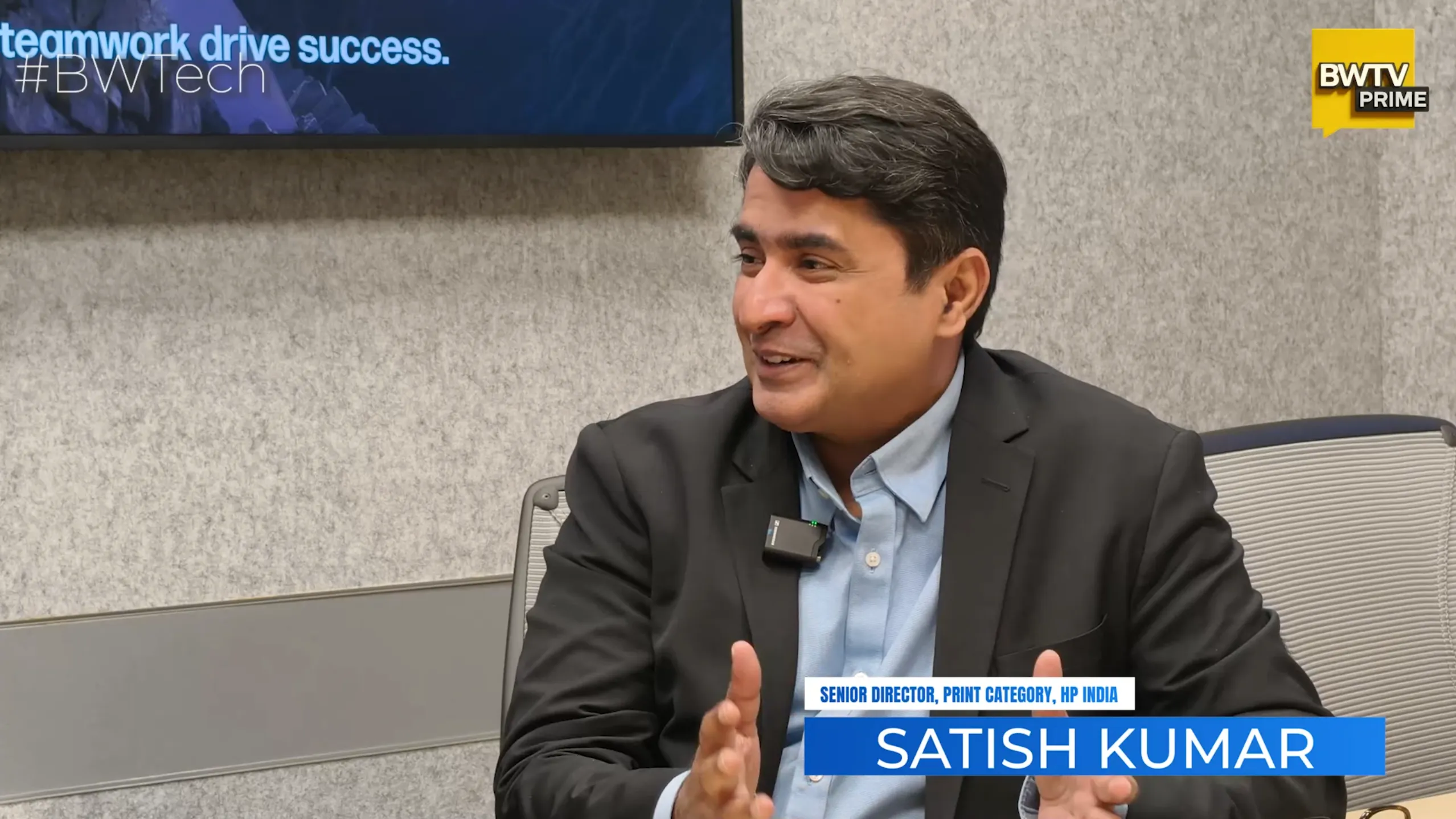
BW Businessworld sat down with HP India’s Senior Director for the Print Category, Satish Kumar, on a busy Monday afternoon on the sidelines of the unveiling of over 20 new products. While the conversation was primarily focused on the future of HP’s print category in India, it did take routine detours to subjects that I personally found fascinating. For instance, a definitive answer to the inkjet vs laser debate, HP’s print as a service concept, and, for crying out loud, do we really need AI in our printers? Kumar’s response to the last one was smoother than I had anticipated. “Why not?”, he asked.
The India Opportunity
The India ink cartridge market was valued at approximately USD 1.11 billion in 2024, projected to grow at a CAGR of 7.3 per cent to reach USD 2.25 billion by 2034. India's digital printing market stood at USD 1.4 billion in 2024 and is projected to reach USD 2.9 billion by 2033 at a 7.8 per cent CAGR. These numbers indicate an opportunity waiting to be grabbed.
India has over 63 million MSMEs (Micro, Small, and Medium Enterprises) that serve as the backbone of the economy, contributing roughly 30% to India's GDP and over 40% of exports. Rising student populations and offline examination culture sustain consistent print demand. Government e-Marketplace (GeM) procurement, a market that grew 10.6 per cent YoY in 2024, drives copier and laser printer volumes. The post-pandemic demand for printing equipment due to the onset of the hybrid work culture is the cherry on top. Demand for home office and small office printing has held steady since COVID-19. India's urbanisation grew 2.3 per cent in 2024, expanding the consumer base for personal printers.
HP India told us that it held a 30.6 per cent market share as of 2025, making it a leader in the print segment. Now, can something as novel as AI integration into printers shift these numbers, or will emphasis on core needs like reducing cost per print and energy consumption still be the most influential factors in printer purchase?
The following discussion focuses on the integration of AI into printers, HP's strategy to address evolving customer needs beyond just cost per print, and how the hybrid work culture is influencing the print business. Key themes include the necessity of AI in printers for enhanced user experience and cost reduction, and HP's holistic approach to serving customers through integrated solutions.
Here are the excerpts from the interview.
Q: Printers have traditionally been a straightforward category. You put in paper, you get a print. Now HP is talking about AI in printers. Do we really need AI in printing?
SK: I think you answered the question yourself by pointing out that AI is everywhere. The real question is: why not in print? And print, from a productivity standpoint, is essential. Take the example of home users. Many people regularly print recipes, articles, and children's worksheets directly from web pages. The problem is that a web page carries a great deal of extraneous content. What should be a two-page printout ends up being 20 to 30 pages, full of advertisements and navigation elements. AI in print solves that. It reads the web page, understands what you are trying to print, and learns from your behaviour over time. If you regularly print recipes, it will identify and isolate that content. The user experience becomes seamless, you waste less paper, and over time, the system builds a profile of how you print. This is just the beginning, but it takes a significant amount of frustration out of the process.
Q: Some of your competitors are focusing on reducing cost per print and wattage per page, which matters deeply to SMBs. HP appears to be going in a different direction with AI integration. How does that play out from a business strategy perspective?
SK: Cost will always play a critical role, and we absolutely address it. But the important question is: how does integrating technology serve the customer holistically at a cost? Think of it this way. Security in printing was never something customers asked for. Nobody raised their hand and said, 'I want secure printing.' But when data breaches started happening, security became a non-negotiable, particularly on the enterprise side. AI will follow a similar path. People do not yet know they need it. What we are focused on is ensuring that as we bring technology into printing, the overall cost of operations relative to productivity actually improves. The metric is not just cost per page. If you optimise cost per page but compromise on connectivity, workflow, or reliability, you are not truly serving the customer. That is the lens through which we look at it.
Q: Beyond cost, what are the other factors that are most influencing purchasing decisions in the Indian enterprise and MSME sectors?
SK: Integrated workflow solutions are the single biggest factor. Most SMBs and enterprises today are building their own security layers on top of the device-level security that already exists. They are also thinking about how software and collaboration tools work across printing, PCs, and video-conferencing devices. Customers are no longer looking at a standalone printer. They are asking: What is the end-to-end solution this company can give me, and in what commercial model? Transactional purchases still exist, but contractual arrangements are growing, and rental as a model is coming up in a significant way. Customers want flexibility. A holistic approach to procurement is very much the norm now.
Q: It has been six years since the pandemic reshaped how we work. How has the hybrid work culture affected the print business?
SK: Hybrid work has essentially dissolved the line between the office and home. People are working everywhere, and they are carrying their connected work lives with them. For SMEs in particular, a large portion of the workforce is not going to be in the office. They may need to print invoices or compliance documents from home, from a co-working space, or from anywhere. This has made accessibility to printing far more critical. It has also accelerated the growth of print-as-a-service as a concept. If you walk through any city today, you will find print shops on every corner. Quick-commerce platforms have started listing print as a feature. How we play in those platforms and how we make printing accessible wherever the customer happens to be, that is the challenge and the opportunity that hybrid work has created.
Q: What exactly is HP doing in the print-as-a-service space?
SK: There are two dimensions to it. The first is the offline version: the printing service partners who operate physical print shops. We are working on providing those partners with reliable, productive solutions, primarily around A3 and A4 laser devices, so that their business runs efficiently. For them, printing is their livelihood, so reliability and the right cost structure are paramount. The second dimension is digital. Quick-commerce platforms like Swiggy Instamart and Blinkit are moving into print services. We are exploring how to build an end-to-end solution that works from the moment a customer clicks print on their phone to the moment the document is delivered through a dark-store network. That work is ongoing, but it is a direction we are actively pursuing.
Q: How does all of this connect to HP’s broader ‘one HP’ vision?
SK: The 'one HP' vision is fundamentally about being better together. When you walk into a customer's office, you are not just bringing a printer. You have the entire endpoint range: PCs, printers, and collaboration devices. Add workflow solutions on top of that, and you have an end-to-end spectrum of what a business needs to drive productivity. In any office, there are a few things that truly matter: the personal computer, a shared printer that works efficiently for that environment, and the collaboration tools that connect everyone. HP plays across all three. The second pillar of this vision is security. We invest in security at every endpoint, including the printer and even the toner cartridge. A toner has a chip in it, and that chip is secured. Enterprises take this very seriously. The third element is mobility: our apps that allow users to connect, print, scan, and save to the cloud. These categories used to exist in silos. A printer used to be called a peripheral, an afterthought. Today, it functions as an independent, connected node in the workplace ecosystem.
Q: You mentioned security in printers more than once. How is HP tackling the issue of counterfeit toner, which remains a concern in India?
SK: HP has a worldwide anti-counterfeiting team that operates continuously. When counterfeit products are detected, the team conducts ground-level sampling, and if confirmed, an investigative unit steps in and carries out raids. That said, I want to be clear that toner counterfeiting in India has come down dramatically, especially since COVID. It is quite minimal at this point. Part of the reason is that the channel itself is evolving. Channel partners are now doing contractual business with end customers, which changes the economics significantly. The margins that made counterfeiting attractive in the past are simply not there anymore. We are not complacent; the team continues to monitor the market, but the situation is very much in control.
Q: Let us settle a debate: inkjet versus laser. Which technology wins?
SK: Neither wins outright, and in India, both will coexist for the foreseeable future. In unit terms, it is roughly a 50-50 split right now. The reason is that the two technologies serve fundamentally different needs. Laser is the go-to for micro-SMEs, enterprises, and industry verticals such as banking, financial services, insurance, and pharma, where high-volume, high-speed printing is non-negotiable. Laser simply has no match there for durability and output at scale. Ink, on the other hand, is becoming increasingly affordable and makes far more sense for home users and micro-businesses where print volumes are lower, and the priority is economy, whether for mono or colour pages. So the home segment will lean more toward ink, and the enterprise and heavy-use segments will stay with laser. Unless there is a technology shift that dramatically changes the efficiency equation on one side, that split is not going to change anytime soon.
Q: What is your go-to-market strategy for the SME sector, given how rapidly it is growing in India?
SK: For SMEs, the strategy is currently channel-led, and the channel itself is transforming. It is no longer a purely transactional play. Channel partners are building their own contractual service capabilities, working alongside companies like us. So it is not just about selling a box anymore. E-commerce for businesses is also growing, though it is still in its early stages for this segment. It followed a similar trajectory for the home segment: it took time, and then became a major force. We are watching that evolution closely and making sure we are present wherever a customer has a need. The principle is simple: wherever there is a demand signal, we need to have a way to serve it.
For more tech interactions, keep following BW Businessworld and BWTV Prime. |





