The top 1% of the population in India holds 40% of the wealth, making the country one of the most unequal in the world, according to the 2026 World Inequality Report, released on Wednesday.
Inequality in India has shown no signs of reduction in recent years, said the findings of the study published by the World Inequality Lab.
The richest 10% hold about 65% of the total wealth, the report said.
In terms of income inequality, the top 10% of earners receive about 58% of national income, it said. The bottom 50% get only 15%.
The income gap between the top 10% and the bottom 50% remained stable between 2014 and 2024, according to the report.
The average annual income in India was about 6,200 euros, or Rs 6.49 lakh approximately, per capita on a purchasing power parity basis.
Purchasing power parity is an economic tool that compares the value of different currencies by measuring what the same amount of money can buy in different countries.
The average wealth stands at about 28,000 euros on a purchasing power parity basis.
The female labour participation was “very low” at 15.7% and had shown no improvement over the past decade, the report said.
“Overall, inequality in India remains deeply entrenched across income, wealth and gender dimensions, highlighting persistent structural divides within the economy,” it added.
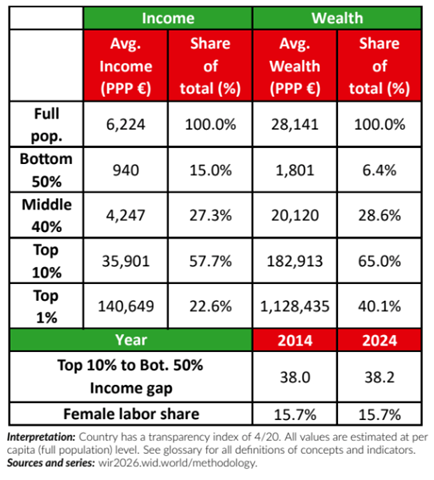 Inequality outlook for India. Source: World Inequality Report 2026Global trends Inequality outlook for India. Source: World Inequality Report 2026Global trends
Globally, wealth has reached historic highs, but remains “very unevenly distributed”, the report said.
It noted that the top 0.001%, which is fewer than 60,000 multimillionaires, owns three times more wealth than the entire bottom 50% of humans put together.
Within almost every region of the world, the top 1% alone hold more wealth than the bottom 90% combined, it added.
The report added that the global financial system continues to be rigged in favour of the rich countries.
Ricardo Gómez-Carrera, the lead author of the report, said that inequality is “silent until it becomes scandalous”.
“This report gives voice to inequality – and to the billions of people whose opportunities are frustrated by today’s unequal social and economic structures,” Gómez-Carrera added.
The World Inequality Report was launched in 2018. Third edition, published on Wednesday, was released in the context of South Africa’s presidency of the Group of 20 in November, which highlighted two crises: the explosion of global inequalities and the weakening of multilateralism, the analysis said.
The report explores the new dimensions of inequality defining the 21st century, such as climate, gender inequalities, unequal access to human capital, asymmetries in the global financial system and territorial divides that are reshaping democracies.
Also read:
|





