At BW Businessworld, we got in touch with renowned designer Raseel Gujral Ansal, who works across interior, spatial, and product design, to discuss her design journey, the latest art exhibition she has curated, and more.
Q. You have been a successful designer for over three decades. Please tell us about your journey and your design language.
I started working in October of 1986; this October it will be forty years. I believe design is about a compulsion to express. One feels there is a compulsion to create and express, and that is why one is a practitioner.
My training took place in my father's and brother’s architectural studio; the first part of my journey was in interior architecture. To begin with, for the first five years, I was not given any of their clients; I was asked to get my own clients, which was how they were getting me ready for the life of a professional who must prove her worth.
Some of my initial projects were office interiors and retail stores, which gave me a lot of flexibility to learn. I experimented a lot with materials and methods at that time. I also designed the interiors of homes, and I remember one of my initial projects was the home of Richard Streiter, the first Dean of the National Institute of Fashion Technology (NIFT) in New Delhi.
I came from an environment where my father’s taste was very contemporary, my mother’s was traditional, so I would say I was an amalgam of their tastes. In my practice, I was leaning towards the contemporary at a time when people thought good taste was traditional or colonial. I carried on for almost ten years before it became fashionable, and then everyone liked the contemporary and wanted minimal; however, I was not minimal. I was bold, Indian and original in my creations. Over time, my design language has evolved, but it is essentially a layering of these three core aspects.
What are some of the projects you are working on at the moment?
Currently, I am working on a temple complex in Kurukshetra for ISKCON, and then there is a spiritual centre in Tankara, Gujarat, for the Arya Samaj. I am also doing high-end residential projects in Delhi, Hyderabad, and Goa.
In all these years, which has been the most exciting project you have worked on?
I have liked all my projects; however, the most gratifying has been my own home because I was not answerable to anyone. That said, as a designer, one must understand what the client wants and then guide the process based on the brief given without stamping oneself all over the project. This balance, and the creation of something new, is the beauty of the practice.
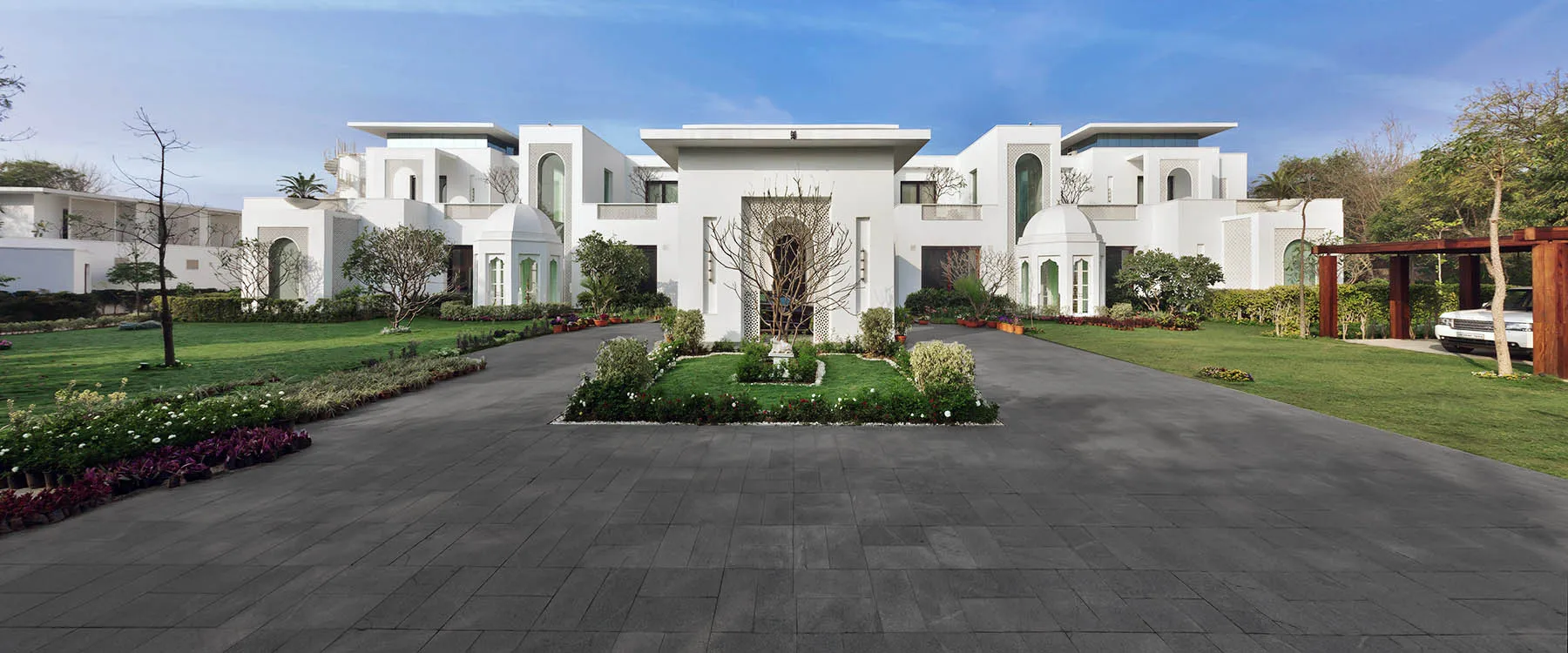
Chand Bagh (Raseel Gujral Ansal's residence) - Chand Bagh is a refined expression of contemporary Indian luxury, envisioned by Raseel Gujral Ansal. Set amidst lush greens, the residence balances architectural clarity with layered artistic detail. The 32 ft. high ceiling Lodhi-inspired Domes stand out like no other. Expansive glass, sculptural elements, and curated materials create a seamless dialogue between indoors and outdoors.
How much has your father, the celebrated artist Satish Gujral, influenced your taste?
If you were to look at your own genetic makeup or personality, it would be hard for you to separate what came from your parents. I was positively influenced by my parents’ taste, not just my father’s but also my mother’s. I carry the traditional aspect of my mother's taste, the boldness and contemporary aspect of my father’s taste, along with his strong work ethic.
What is your view on sustainability, and how are you incorporating it in your practice?
Sustainability means so many things to people; to me, it would be architecture that is compatible with the climate, and as a result, conserving energy and resources. Also, using local products, including crafts in one’s practice and helping the community that practices it. For me, all this means conscious design that sustains culture, resources and livelihoods.
Your view on Artificial Intelligence (AI) in design?
I believe it is a useful tool that can aid in the process, but it definitely should not take over the process. The creative aspect must always be with the designer and not with technology. I worked with AI for my last art exhibit titled ‘Is this my circus?'. Here, ideas and compositions came from my memory, imagination and intuition. These were explored further in collaboration with AI, my team and I refined the compositions, and finally, the images were brought to life with colour by master craftsmen.
Please tell us about the current exhibition, Dakhin Dilli.
Having grown up around art forms like Pichwai and Tanjore paintings, I have developed a strong appreciation for these genres. However, many people, especially the younger generation, are not well-versed in them. This exhibition helps people engage with these art forms.
I believe devotion is a universal concept. Through this exhibition, we tell a story of how North India influenced South Indian devotional art and vice versa, carried across trading and pilgrimage routes. The exchange led to the creation of some extraordinary artworks. On display are Pichwai artworks, Tanjore paintings, Mysore paintings, Raja Ravi Varma Oleographs, sculptures and artefacts.
Quick Facts:
As per reports, the Interior Design Market in India is growing at a CAGR of 12.87 per cent and is pegged to reach USD 65.01 billion by 2031.
The Indian architectural services market is expected to reach USD 43,662.4 million by 2033.
Sources: Mordor Intelligence, Grand View Research |





