By S. Gurumurthy
The world today stands at a historic crossroads.
The geopolitical order built after World War II is visibly weakening. Wars continue across regions. Economic systems are fragmenting. Societies are becoming internally polarised. Cultural conflicts are intensifying. Even the institutions that once claimed to uphold a stable global order increasingly appear exhausted and unable to respond to the crises of our times.
This is not merely a political or economic crisis. It is fundamentally a civilisational crisis.
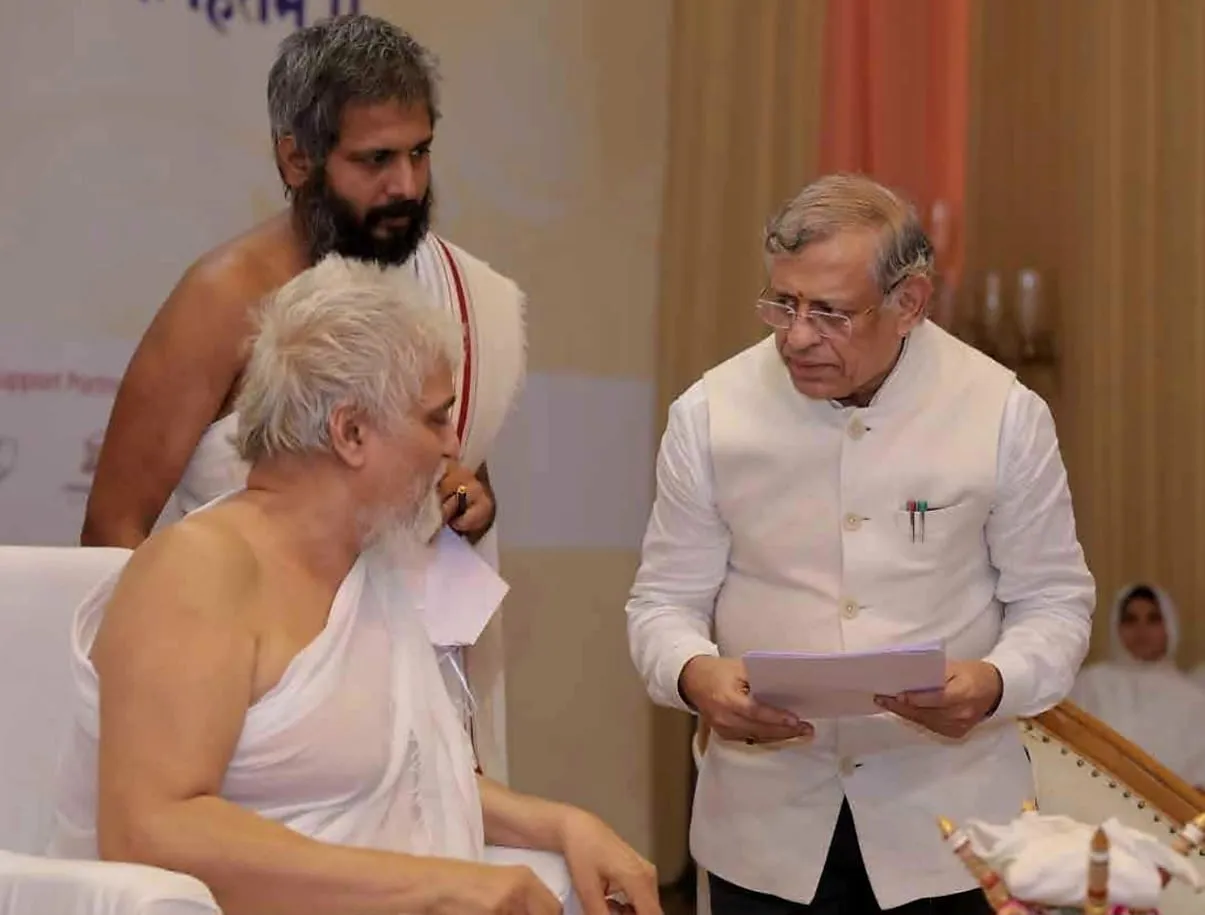
It was this understanding that brought me earlier this year to Mumbai’s August Kranti Maidan, where I participated in the fourth edition of Vasudhaiva Kutumbakam Ki Oar under the guidance of HH Jainacharya Yugbhushansuri Maharaja, the 79th successor to Tirthankar Shri Mahavir Swami.
I had been invited by HH Maharaja in my capacity as Chairman of the Vivekananda International Foundation. What I witnessed there was not merely a spiritual gathering or a cultural convention. It was a serious and multidimensional attempt to build an alternative philosophical framework for the future world order.
 I say this with full responsibility: the initiative was an eye-opener even for me. I say this with full responsibility: the initiative was an eye-opener even for me.
At Vivekananda International Foundation, we have long attempted to bring a civilisational perspective into strategic and geopolitical thinking. Modern geopolitics largely functions within the framework of power — dominant power, balance of power, strategic control, comprehensive national power and the inevitability of conflict. But HH Maharaja’s articulation of Vasudhaiva Kutumbakam moved the discussion beyond geopolitics into something far deeper.
It introduced the idea of “spiritual sovereignty.”
My colleague Dr. Arvind Gupta, Director of VIF, had attended an earlier edition of the initiative and strongly urged me to meet HH Maharaja. When I eventually met him in Ahmedabad before the Mumbai convention, the experience itself became symbolic of the philosophy he was articulating.
Late in the evening, I entered a saint’s camp functioning without electricity, without fans, without modern excesses that today’s world considers indispensable. There, I did not merely hear philosophy — I saw the spirit of the Isavasya Upanishad in practice: take only as much as necessary so that others too may fulfil their needs.
In that simplicity was a profound critique of modern civilisation.
During our conversation, HH Maharaja spoke not only about spirituality, but about sovereignty, civilisation, geopolitics, religion, culture and diversity. His central argument was striking: political sovereignty cannot survive long without spiritual sovereignty.
This insight becomes especially important in the context of the world order that emerged after World War II.
For decades, the post-war system was built almost entirely around the grammar of power — military power, economic power, institutional power and ideological power. The assumption underneath it was that the Western worldview represented the universal model for humanity and that non-Western civilisations needed to modernise by disconnecting from their ancient cultural and spiritual foundations.
Few people remember today that a 1951 United Nations advisory on development openly suggested that “ancient philosophies” and traditional social structures in non-Western societies would need to be dismantled for economic progress to occur.
This reflected a deeply Euro-American anthropological mindset — one that viewed the non-Western world as something to be reshaped into a one-size-fits-all model of modernity.
The greatest flaw of that order was its inability to understand diversity.
The Indian philosophical tradition has always recognised that there can be multiple truths, multiple paths and multiple ways of organising society. Ideology insists there is only one correct worldview. Philosophy allows coexistence.
That is the essence of Vasudhaiva Kutumbakam.
Ironically, the global system formally acknowledged cultural diversity only in 2001 when the UN adopted the Convention on Cultural Diversity — more than half a century after the institution was formed. Yet even that framework subordinated culture to a universal rights model centred exclusively on the individual rather than civilisational collectives.
India’s civilisational framework has historically been different.
Even Mahatma Gandhi refused to endorse an early draft of a global human rights charter circulated by HG Wells. Gandhi instead suggested a charter rooted in duties — duties towards fellow humans, society and nature — reflecting the Indian concept of Dharma.
The post-war order ignored such frameworks because it was fundamentally anti-civilisational.
But today that order is visibly weakening.
What we are witnessing globally is the return of civilisational consciousness.
Russia now openly defines itself as a civilisational state after decades of communist suppression of its spiritual heritage. China increasingly invokes thousands of years of civilisational continuity as the basis of its future rise despite once attempting to erase its own cultural memory during the Cultural Revolution. India too is increasingly being recognised globally not merely as a nation-state, but as an ancient civilisation reasserting itself.
This transition is historic.
The decline of the West is not simply an economic or political phenomenon. It reflects the exhaustion of a purely ideological and power-centric model of organising humanity.
The future world order cannot be sustained merely through military alliances, trade arrangements or institutional mechanisms. It requires a deeper philosophical foundation that respects cultural diversity, spiritual traditions and the right of civilisations to exist without being forced into uniformity.
This is where HH Maharaja’s articulation of Vasudhaiva Kutumbakam acquires profound importance.
What makes the initiative significant is that it is not confined to religious discourse. HH Maharaja has attempted to bring together spiritual institutions, strategic thinkers, intellectuals, social organisations and opinion-makers into a multidimensional civilisational movement.
The concept is not utopian idealism. It is an attempt to create a durable framework for coexistence in a world increasingly fractured by ideological absolutism, identity conflicts and geopolitical fragmentation.
The world today does not merely need economic reforms or geopolitical restructuring. It needs a civilisational reset.
And India, through its ancient philosophical traditions and its enduring spiritual consciousness, may have a historic role to play in shaping that future. |





