Delhi in April is not a city. It is a verdict. The heat arrives before you have finished your morning chai, sits on your chest like a debt collector who has given up being polite, and by noon has turned the roads into a shimmering, horn-blaring, magnificently furious pressure cooker in which every traffic light is a personal insult and every auto-rickshaw is driven by someone who has made his peace with mortality. In this environment, your phone is not a gadget. It is infrastructure. It runs your maps, your payments, your arguments, your reels, your WhatsApp groups in which forty-seven people are debating a restaurant that closed in 2019. And when it dies at 4 PM — which it will, because every phone dies at 4 PM in Delhi in April, because that is when Delhi is most merciless and you are furthest from a charger — something collapses inside you that is only partly about the phone.
The OnePlus Nord 6 did not die at 4 PM. It did not die at midnight. It did not die the following morning, or the morning after that. Across three days of genuine, unreasonable, Delhi NCR use — Call of Duty Mobile at 165 frames per second, five reels cut across VN, Edits, and InShot, Google Maps navigating the specific madness of Noida expressways at rush hour, WhatsApp operating at newsroom velocity — the charger stayed in the bag. Just sat there. Redundant. Slightly offended.
This is what the OnePlus Nord 6 is. Everything after this paragraph is the explanation of how, and the honest account of what it cost to get here.
The Brand Is On Fire. As Is The Phone
In late March 2026, Robin Liu — OnePlus India's CEO — quietly stepped down and returned to China. No successor was named. The Economic Times cited "ongoing restructuring of the company's business in global markets." A tipster briefly posted, then deleted, claims that OnePlus would shutter operations across the US, UK, and European Union as early as April 2026. IDC measured OnePlus India's market share collapsing from 3.9 per cent in 2024 to 2.4 per cent in 2025 — a 38.8 per cent decline, the steepest of any brand in the country that year. CyberMedia Research logged a 32 per cent shipment drop. The partner-run exclusive offline stores were asked to close. Three company-owned outlets remain. Counterpoint Research confirmed what everyone in the industry already knew: rising input costs and lower global demand are squeezing margins with the enthusiasm of a particularly motivated debt collector.
Into all of this, OnePlus launched the Nord 6 with a product event. Livestreamed. As though the house were not, in several markets, demonstrably on fire.
There is something either brilliantly defiant or magnificently delusional about that decision — and the honest answer is probably both, living together in a corner office in Shenzhen. The Nord series is OnePlus's India insurance policy. The line that has kept the brand alive in the one market it genuinely cannot afford to lose. The Nord 6, then, is less a product launch and more a declaration: we understand what Indian users need, we built it for them, and we are going to stand in this burning building and present it to you with a straight face. Whether the brand has the organisational stability to honour that declaration long-term is a question nobody at OnePlus is currently answering in public. The phone, however, makes its own case — and it makes it rather well.
Quick Silver and the Art of Looking Richer Than You Are
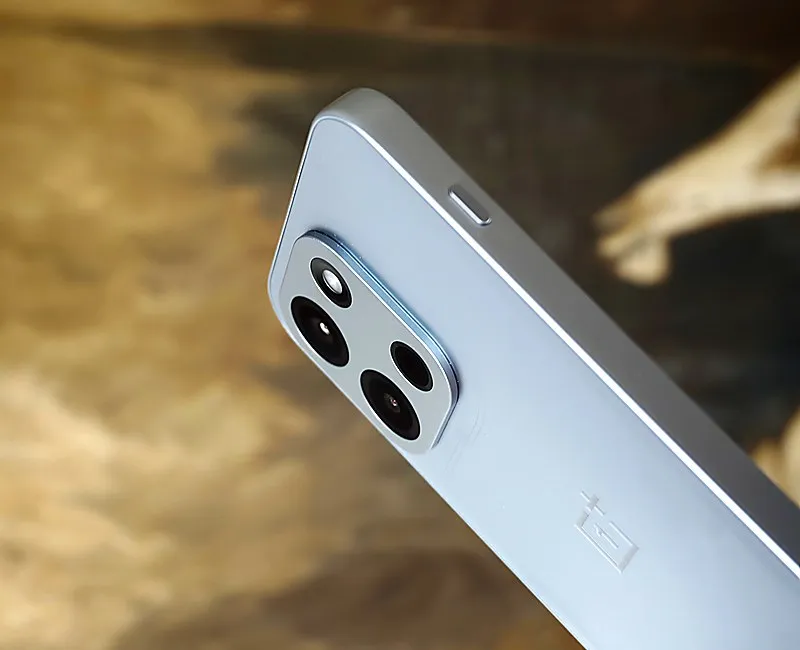
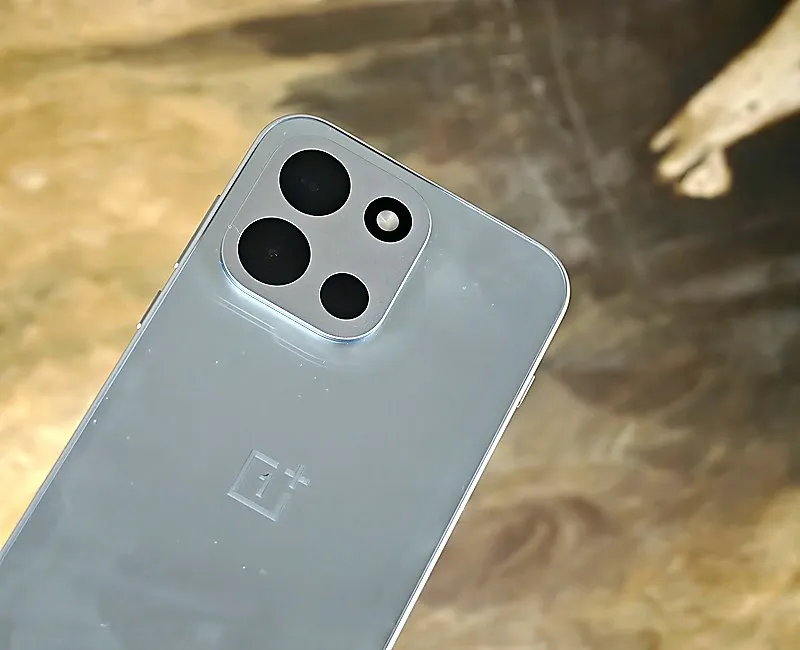
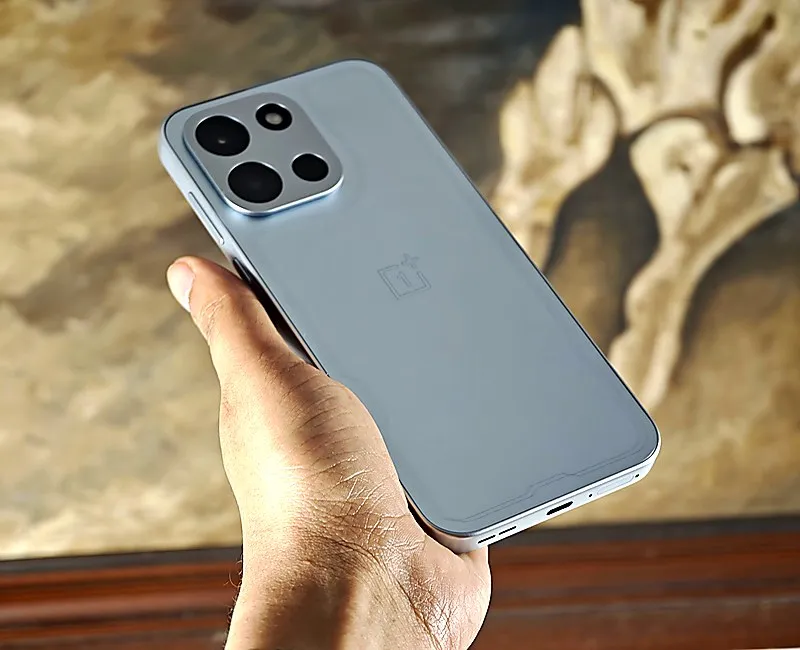
The Quick Silver colourway is genuinely beautiful in the way that certain watches are beautiful — composed, slightly self-assured, interesting enough to notice without being loud enough to regret. The patterned back catches light with the restrained theatrics of a well-cut blazer. Familiar enough that your parents would pick it up without alarm. Interesting enough that you would put it face-down on a restaurant table specifically so people could see the back. The squircle camera island, borrowed directly from the OnePlus 15 series' design language, gives the rear a visual anchor that communicates premium intent without screaming about it. The flat metal frame is angular and deliberate. This phone looks like it costs Rs 55,000. It costs Rs 41,999. That gap is one of the finer conjuring tricks in consumer electronics.
The Nord branding gives the game away with the subtlety of a foghorn at a funeral. "Nord" has always meant mid-range. It means mid-range now. And while the hardware assembled inside this chassis genuinely deserves a more ambitious name, the label does its honest work: it tells the market exactly where this sits in the hierarchy, and the hierarchy is not fooled.
It is also, and there is no elegant way to say this, chunky. The 9,000mAh silicon-carbon battery does not slip discreetly into a slim trouser pocket. It announces its presence with the quiet confidence of someone who knows they are the most important person in the room. For the person who carries a minimalist wallet and considers trouser pockets a sacred geometry, this is a problem. For the person who has spent too many conference days stalking the one free charging point behind a potted plant near the registration desk — the phone's mass is a liberation. It is the direct physical expression of the Nord 6's greatest virtue. You simply have to decide which kind of problem you prefer.
IP66, IP68, IP69, and IP69K ratings. MIL-STD-810H military-grade testing. Crystal Guard Glass on the front. Corning Gorilla Glass Victus+ on the back. You can submerge this phone, blast it with high-pressure water jets, and drop it from chest height with the breezy confidence of someone whose warranty is fully intact. In a country where phones meet their end on tiled bathroom floors and rain-slicked road crossings with depressing regularity, this is engineering that earns its place on the specification sheet.
The Display That Makes Everything Else Look Like It Has a Cold
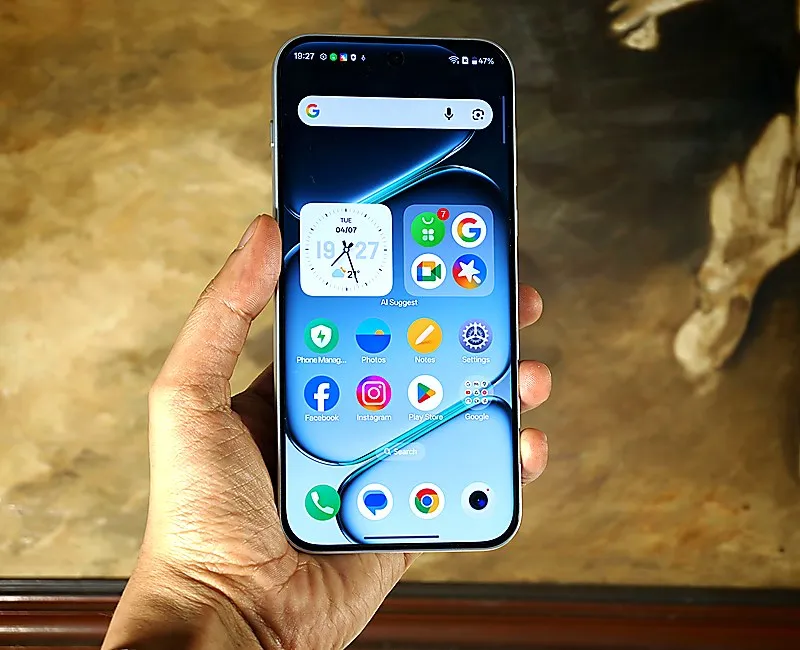
Before the numbers: close your eyes and imagine scrolling through Instagram at the pace your thumb actually wants to go, and the content moving with it the way water moves — no hesitation, no drag, no sense of the screen catching up to your intentions. That is 165Hz. That is what this display does, continuously, as a baseline condition of existence. The 6.78-inch 1.5K AMOLED panel at 165Hz achieves a fluency that makes every 60Hz screen you have used previously feel like it was operating through mild sedation.
The Ferrari analogy is the right one: a 488 Pista, loaded with downforce, taking the 130R at Suzuka at full tilt. The physics are on a different plane. Once you have driven that corner at that speed, a road car feels permanently compromised. This display does the same thing to your expectations of what a screen should feel like. You will look at other phones afterwards and notice, with mild irritation, that they are simply slower.
Peak brightness of 3,600 nits means outdoor legibility under Delhi's April sun is a solved problem — no squinting, no tilting, no holding the phone at the specific seventeen-degree angle that almost works. The 3,840Hz PWM dimming rate matters for the considerable number of people who get headaches from lower-quality displays and have spent years assuming it was just something that happened to them. Aqua Touch 2.0 keeps the display responsive with wet fingers. At this price, this display has no rival. That is a statement worth making plainly, without qualification, because it is plainly true.
Formidable, Honest, & Not Pretentious
On the road from Connaught Place to Sector 18 Noida — forty-five minutes of Delhi traffic, which is to say forty-five minutes of a game in which the rules change every thirty seconds and the other players are all convinced they are winning — Call of Duty Mobile ran at a sustained 165 frames per second. The 3,200Hz touch sampling rate meant that every tap, every swipe, every desperate last-second trigger pull landed exactly where it was intended. The phone stayed cool. The game stayed smooth. Five reels, edited across VN, Edits, and InShot, rendered cleanly. No thermal throttle. No fan noise, because there is no fan.
Now the honesty portion, because this is a review and not a press release. In AnTuTu, the 8s Gen 4 posts approximately 2.1 million points. The Snapdragon 8 Elite Gen 5 — which powers the Samsung Galaxy S26 Ultra at roughly double the Nord 6's price — posts around 3.1 million, making it about 48 per cent faster. In Geekbench 6 single-core, the Elite's custom Qualcomm Oryon CPU is 40 per cent faster. In 3DMark, the Elite's Adreno 830 GPU is roughly twice as fast as the 8s Gen 4's Adreno 825. These are not rounding errors. They are real, significant gaps.
The 8s Gen 4 is not in the Elite's league. Stating otherwise would be the kind of dishonesty that gives tech reporting its occasionally deserved reputation for being slightly purchased. What the 8s Gen 4 is, however, is a chip that performs roughly on par with the Snapdragon 8 Gen 3 — which powered 2024's flagships. If that chip was good enough to headline a flagship twelve months ago, it is more than adequate to anchor a premium mid-ranger today. Six years of security patches and four major Android OS updates mean the performance conversation remains relevant long after the competition has moved on.
72 Hours. The Charger Never Left the Bag.
Nine thousand milliampere-hours. Say it slowly, because it deserves the respect.
The sub-Rs 45,000 segment standard sits between 5,000mAh and 5,500mAh. The Nord 6 arrives with a silicon-carbon cell — a newer battery chemistry that packs more energy into a smaller physical volume than conventional lithium-ion — that is nearly double that. The result, across three full days of intensive Delhi NCR use, was that the charger stayed in the bag. Not because the usage was light. Because the battery is, by any reasonable measure, absurd in the best possible way.
What changes when you have a three-day battery is not the battery. What changes is your relationship with your phone. The low-battery anxiety — that specific, grinding modern dread that arrives at 20 per cent and sends you mentally mapping every charging point within a half-kilometre radius — simply does not materialise. You stop checking the indicator. You stop rationing screen time on long days. The Nord 6 resolves that negotiation permanently, comprehensively, and in your favour.
The 80W SuperVOOC charging fills the 9,000mAh cell in approximately 70 minutes — a full charge in the time it takes to watch the first act of a film, or sit through a meeting that could have been an email. The 27W reverse wired charging turns the phone into a power bank for earbuds, a smartwatch, or the colleague whose Samsung is at 3 per cent and ascending toward a full-scale interpersonal crisis. In the sub-Rs 45,000 segment, battery life is a solved problem. The Nord 6 has solved it. Definitively. Everyone else is now playing for second place.
A Tale of 2 Lenses and 1 Honest Reckoning
There is a specific moment that defines the Nord 6's camera: standing in a lane off Chandni Chowk at 9 PM, the air smelling of kebabs and diesel and history, the narrow street lit by the particular warm amber of streetlights that have been there since before mobile phones existed, wanting to capture the scene — the stacked buildings, the tangle of electrical wires, the chai stall glowing at the end of the lane. The 50MP Sony LYTIA primary camera, dual-axis OIS engaged, produced an image that was genuinely lovely. Warm, composed, detailed in the shadows in the way good computational photography manages. The kind of image you send to people and they ask which phone you used.
Then the ultra-wide button. The 8MP sensor, 112-degree field of view, capturing the full width of that extraordinary lane. The result was, to deploy the most precise technical term available, a mess. Noise everywhere. Colour dissolved. The atmosphere of the scene — the thing you were actually trying to capture — gone entirely, replaced by a muddy approximation that no amount of AI processing could rescue. The ultra-wide at night is where the Nord 6's ambitions meet the hard wall of physics. Eight megapixels and a small sensor cannot gather enough light in challenging conditions. This is a statement of fact, not of disappointment.
In daylight, the system works considerably better. The primary camera produces images with confident colour science, solid dynamic range, and stabilisation that makes handheld 4K 60fps footage feel deliberately composed. Against the camera kings of the Indian market — the Oppo Find X9 Pro, the Vivo X300 Pro, the Google Pixel 10 Pro — the Nord 6 is outclassed. Those devices exist at considerably higher price points and they earn the premium through their imaging systems. Against the Nord 6's actual sub-Rs 45,000 rivals, the primary camera competes and occasionally leads. The ultra-wide after dark loses every comparison it enters.
The AI That Earns Its Name
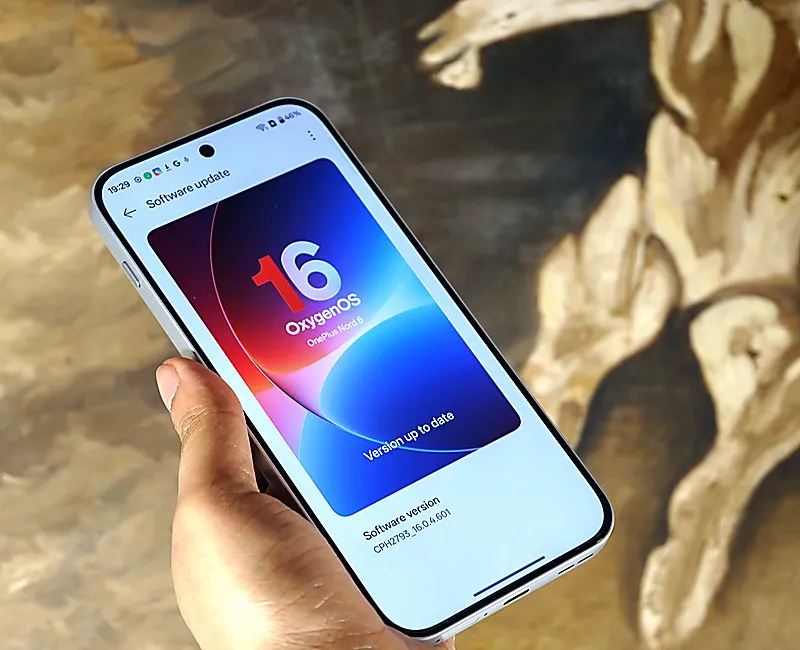
OxygenOS 16 on Android 16 has shed the bloat and identity confusion of the post-merger years — the period when it felt like two software philosophies sharing one phone in increasingly tense silence — and arrived at something clean, fast, and purposeful. Plus Mind, accessible via the dedicated Plus Key on the side of the phone, is the standout feature of the software package. It functions as an intelligent memory layer: save content from your screen with a gesture, and the system builds a searchable, contextualised index of your digital life that compounds in usefulness over time. During the review period, it surfaced a reference from a conversation from weeks prior, contextualised it against related content saved more recently, and made it actionable in about thirty seconds. This is not feature theatre. It is a tool that changes a behaviour.
The Google Gemini integration amplifies it further — Plus Mind's saved data feeds into Gemini's context window, enabling responses that reflect your actual history and preferences. The writing tools — AI Ghostwriter, real-time translation, AI Scan for documents — earn their presence. Four major Android OS updates and six years of security patches mean the software investment will appreciate rather than depreciate.
What OnePlus Built, What It Means, and Why It Matters
OnePlus built this phone while its India CEO was stepping down, while restructuring rumours were circulating with enough credibility to move markets, while its offline retail network was contracting to three stores, while IDC was recording the steepest market share decline of any brand in India in 2025. It built it, priced it aggressively, confirmed a launch date, and held the event. That is either the behaviour of a brand that genuinely believes in its product and its market — or a brand performing confidence it does not entirely feel. Possibly both. Probably both.
Three days without a charger, in Delhi, in April. That is the Nord 6's argument. It is a very good one. The camera ultra-wide at night is the rebuttal, sitting there, unmoved, at the centre of every honest conversation about this device. For most people, in most situations, the argument wins. For the mobile photographer who shoots after dark, the rebuttal wins instead.
The rest of the sub-Rs 45,000 field has until the next upgrade cycle to find a response. Given what it is responding to, that will require genuine effort.
OVERALL VERDICT
8 / 10
OnePlus Nord 6 · Rs 41,999 · 12GB/256GB
The class of the sub-Rs 45,000 field in 2026. The 9,000mAh battery redefines endurance at this price. The 165Hz 1.5K AMOLED is the finest screen in its segment. The Snapdragon 8s Gen 4 handles everything daily use demands. Plus Mind AI is genuinely useful. One honest flaw: the 8MP ultra-wide fails after dark and there is no telephoto. Every other argument, won.
SCORE BREAKDOWN
CATEGORYSCORENOTESDesign8/10
Quick Silver earns its name; the heft is the battery's price of admissionDisplay9.5/10
165Hz 1.5K AMOLED at 3,600 nits; the finest screen under Rs 45,000 in 2026Performance8/10
Snapdragon 8s Gen 4 handles daily demands; not 8 Elite territory, and it knows itCamera6.5/10
Primary is strong; 8MP ultra-wide fails after dark; no telephoto; Oppo, Vivo, Google win hereBattery Life10/10
Three days in Delhi in April. The category argument is over.Software & AI8.5/10
OxygenOS 16 on Android 16; Plus Mind is genuinely useful; six years of security patchesFeatures8.5/10
IP66/68/69/69K, MIL-STD-810H, 165FPS gaming, 3,200Hz touch, Wi-Fi 7, Plus KeyValue for Money9/10
Rs 41,999 for this hardware package is genuinely difficult to counterOverall
8/10
The class of the sub-Rs 45,000 field in 2026. One honest flaw. Every other argument, won.
OnePlus Nord 6 price in India: Starting at approximately Rs 41,999 (12GB/256GB). Available on Amazon India and the OnePlus website from April 9, 2026, in Quick Silver, Fresh Mint, and Pitch Black. |





