The semiconductor and electronics industry wants the government to shift its Budget 2026 strategy from headline-grabbing fab investments to policies that create domestic demand, reward Indian intellectual property (IP) and ease cost pressures for design-led startups, industry leaders tell BW Businessworld.
While the government committed more than Rs 26,000 crore to semiconductor and electronics ecosystem in last year's budget and announced large fabrication and OSAT projects over last few years, executives say the next phase of India’s chip mission must focus on outcomes rather than infrastructure alone.
Focus On Domestic Outcomes
“India has committed significant public capital to fabs and OSATs, but the next phase of the semiconductor mission must focus on outcomes, not just infrastructure,” said Raja Manickam, Founder and CEO at iVP Semi and former CEO of Tata OSAT. “True progress will be measured by how much of India’s semiconductor demand is built and met locally.”
Despite serving a global semiconductor market of over USD 500 billion and rising domestic demand from power, mobility and renewable energy sectors, India still imports nearly all the chips it consumes, Manickam said, warning that without targeted policy support, domestic firms risk being confined to low-risk services for foreign companies.
“Semiconductors are still a new business for India,” he said. “Putting more money into traditional players will not get our objectives of semiconductor independence. Traditional, large companies are good at scaling or creating lateral business using traditional financial tools like IRR, ROI, ROCE etc. They are not good at developing new business which is driven by passion and core believes with good networking of the ecosystem which is outside of India. Government support is needed to help nurture these companies.”
Industry Seeks Demand-Side Support & Government Procurement
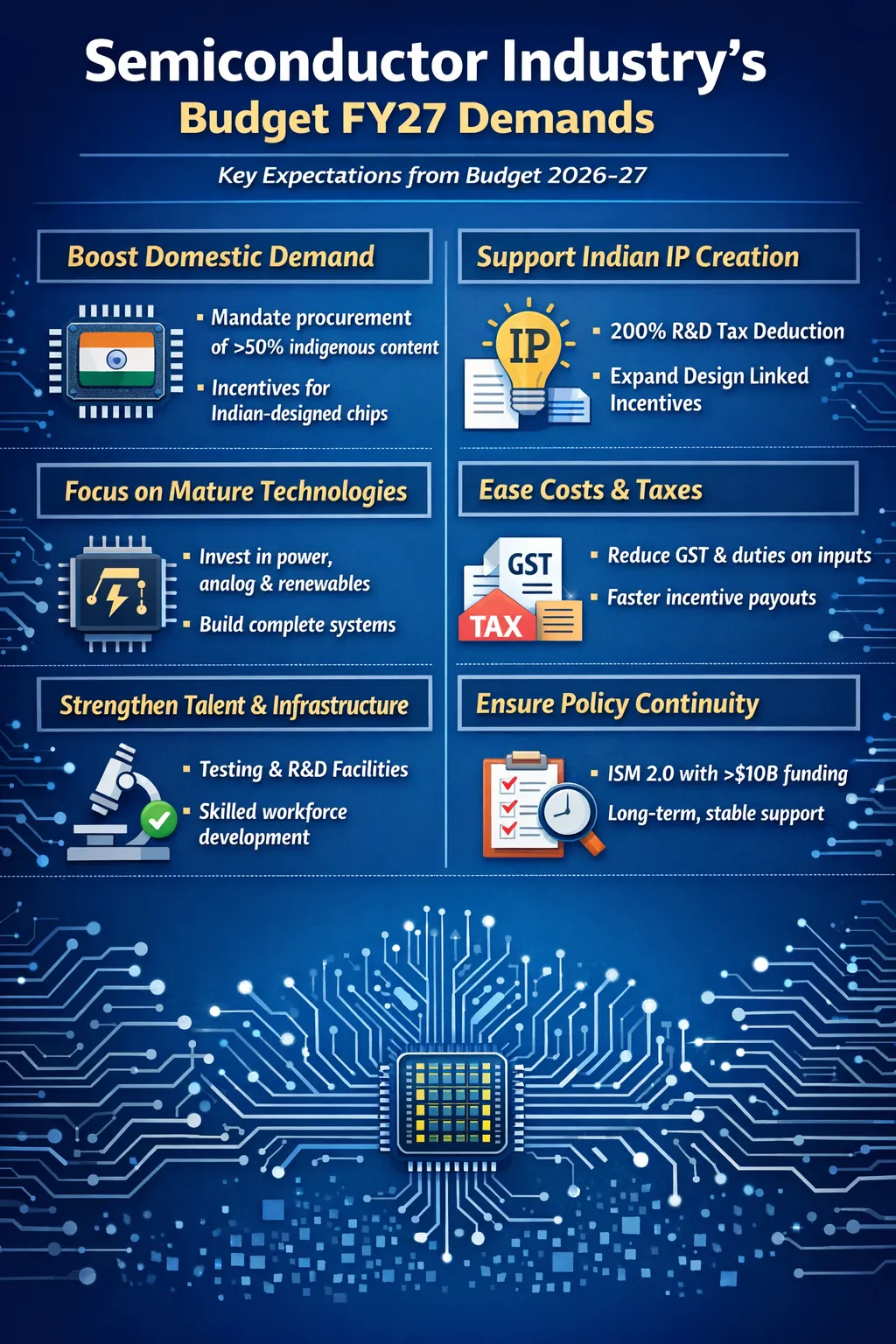
Industry leaders say a central gap in the current policy framework is the absence of demand-side incentives. Several executives called for the government to act as an anchor customer and actively promote adoption of Indian-designed chips.
“As India looks to accelerate its semiconductor journey, Budget 2026 is a chance to move from intent to impact,” said Hareesh Chandrasekar, CEO and Co-founder at AGNIT Semiconductors. “Equally important is positioning the government as the first customer by mandating a share of public procurement from startups with over 50 per cent indigenous content, creating early demand for deep-tech innovation.”
Executives also pressed for rationalisation of taxes and faster payouts to ease cash-flow pressures faced by chip design and deep-tech firms, which typically operate with long development and commercialisation cycles.
“Rationalising GST for semiconductors designed and manufactured in India, and easing upfront GST on critical inputs for deep-tech startups, will ease cash-flow pressures,” Chandrasekar said.
Push For Indian IP Creation And Ownership
A major demand from the industry is a sharper focus on IP creation and ownership in India, bringing it in line with global practices in key semiconductor hubs.
“India is on a trajectory from ‘Assembled in India’ to ‘Make in India’ and ‘Invented & Made in India’,” said Sanjeev Gupta, CEO of Karnataka Digital Economy Mission. “To truly unlock the USD 300 billion electronics vision by 2030, this Budget must incentivise creation of intellectual property by Indian companies.”
Gupta urged the government to introduce a 200 per cent weighted tax deduction on R&D expenditure for the ESDM sector and expand the Design Linked Incentive (DLI) scheme by increasing its fiscal cap fourfold, from Rs 15 crore to Rs 60 crore, for strategic deep-tech startups.
“To get the 200 per cent tax break or the Rs 60 crore DLI, the government can mandate that the primary patent must be filed in India and the intellectual property must be owned by an Indian-incorporated entity,” Gupta said, adding that such conditions could also encourage multinational firms to establish Indian IP-holding subsidiaries.
Design Startups Seek Faster Payouts, Lower Input Costs
Design-focused startups seconded these demands, adding that there was a need for faster incentive disbursements and lower input costs.
“For chip design firms, quicker payouts and wider coverage under the Design Linked Incentive scheme will make a real difference,” said Nikul Shah, co-founder and CEO at IndieSemiC. “Budget 2026 should also consider tax relief on R&D spending, lower GST on expensive inputs such as EDA software, MPW runs, and prototyping, and reduced customs duties on specialised components.”
Shah said regulatory simplicity and policy stability were critical for an industry characterised by high upfront costs and long timelines. “With India’s semiconductor market expected to cross USD 100 billion by the end of this decade, targeted budget support can help Indian design companies scale and build strong IP from India,” he said.
Execution Discipline & Talent Pipeline
Beyond incentives, industry executives said execution discipline and ecosystem infrastructure would determine whether India’s semiconductor ambitions translate into sustainable jobs.
“This budget should focus on building execution discipline within the sector – continuity of incentives, predictable payouts, ecosystem infrastructure like testing and certification facilities, and enhanced R&D credits rewarding domestic value addition,” said Neeti Sharma, CEO at TeamLease Digital.
Such measures would support growing demand for skilled talent, including process engineers, yield and reliability experts, advanced packaging technicians and design-system professionals, she said.
 |





